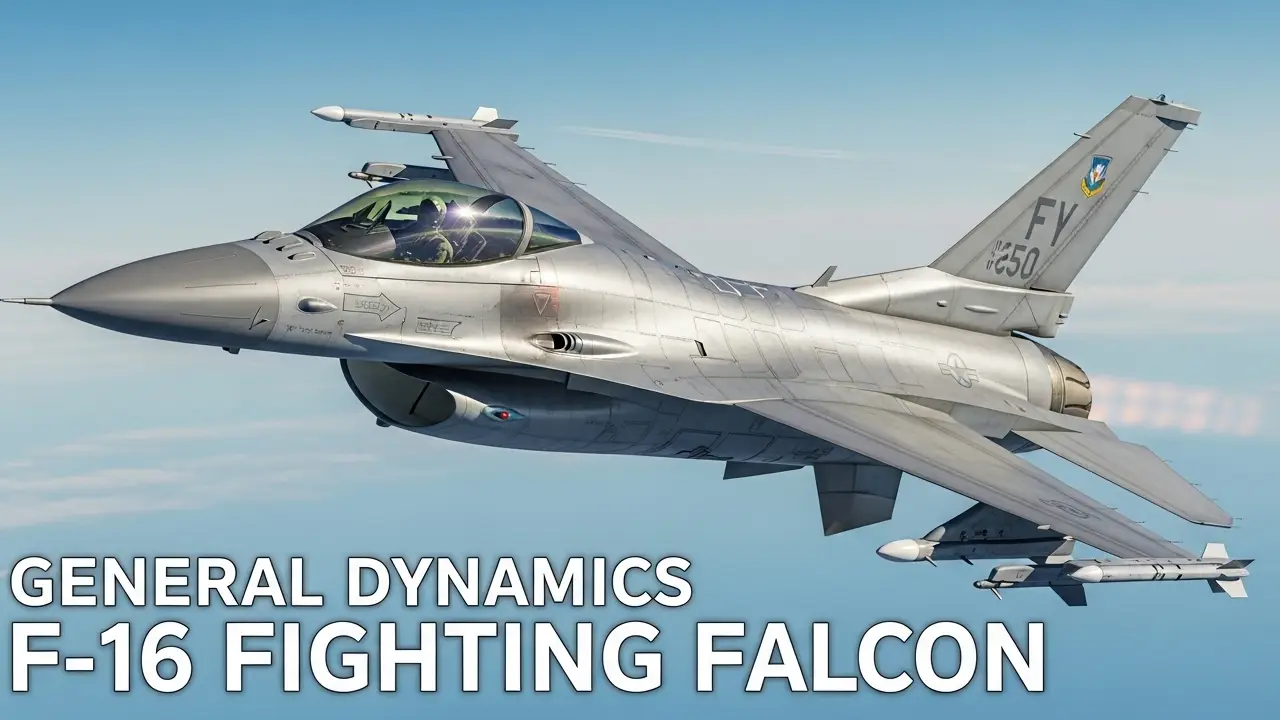
The General Dynamics F-16 Fighting Falcon remains one of the most widely used and respected multirole fighter jets in modern aviation history. Since its introduction in the 1970s, the aircraft has evolved significantly, maintaining relevance across decades of technological advancement and global military requirements.
Known for its agility, cost-effectiveness, and combat versatility, the F-16 Fighting Falcon continues to serve in the air forces of more than 25 countries. This article explores its design, features, performance, and why it still plays a vital role in global defense systems.
Origins and Development of the F-16 Fighting Falcon
The F-16 Fighting Falcon was originally developed by General Dynamics, now part of Lockheed Martin, as part of a lightweight fighter program for the United States Air Force. The goal was to create an aircraft that offered superior maneuverability, reduced costs, and improved pilot visibility.

First flown in 1974 and introduced into service in 1978, the aircraft quickly gained recognition for its innovative design. It was among the first fighter jets to feature a fly-by-wire control system, which improved handling precision and responsiveness.
Design and Key Features
The General Dynamics F-16 Fighting Falcon stands out due to its sleek aerodynamic design and advanced avionics. Its frameless bubble canopy provides pilots with exceptional visibility, which is critical during air combat situations.
The aircraft is equipped with a side-mounted control stick and a reclined seat, reducing pilot fatigue and allowing better control during high-speed maneuvers. Its lightweight structure contributes to improved agility and fuel efficiency.
Performance and Capabilities
The F-16 Fighting Falcon is known for its impressive speed, maneuverability, and combat performance. It can reach speeds of over Mach 2 and operates effectively in both air-to-air and air-to-ground missions.
Its advanced radar systems, targeting pods, and precision-guided weapons enable it to carry out a wide range of missions, including interception, ground attack, and reconnaissance. The aircraft is also capable of operating in all weather conditions.
Global Usage and Operational History
The General Dynamics F-16 Fighting Falcon has been used in numerous military operations around the world. Countries across Europe, Asia, and the Middle East rely on the aircraft due to its adaptability and relatively lower operating costs.
Over the years, the F-16 has been upgraded with modern avionics, improved engines, and enhanced weapon systems. These upgrades ensure that the aircraft remains competitive with newer generation fighters.
Modern Upgrades and Variants
The F-16 Fighting Falcon has undergone several upgrades, including the latest F-16V variant, also known as the Viper. This version includes advanced radar systems, improved cockpit displays, and enhanced electronic warfare capabilities.
Modern versions are equipped with AESA radar, which provides better target detection and tracking. These improvements allow the aircraft to perform effectively in modern combat environments where electronic warfare plays a critical role.

Why the F-16 Still Matters Today
Despite the introduction of fifth-generation fighter jets, the General Dynamics F-16 Fighting Falcon continues to be relevant. Its lower cost compared to newer aircraft makes it an attractive option for many countries looking to maintain strong air defense capabilities.
The aircraft’s proven reliability, ease of maintenance, and versatility ensure that it remains in active service. Continuous upgrades further extend its operational lifespan.
Specifications of General Dynamics F-16 Fighting Falcon
| Specification | Details |
|---|---|
| Manufacturer | General Dynamics / Lockheed Martin |
| First Flight | 1974 |
| Maximum Speed | Mach 2 (approx. 2,414 km/h) |
| Range | 4,220 km (with external fuel tanks) |
| Crew | 1 (single-seat) or 2 (trainer variants) |
| Engine | Pratt & Whitney F100 or GE F110 |
| Role | Multirole Fighter |
Conclusion
The General Dynamics F-16 Fighting Falcon has proven itself as a reliable and adaptable aircraft over several decades. Its combination of performance, affordability, and continuous upgrades makes it one of the most successful fighter jets ever built.
As global defense needs continue to evolve, the F-16 remains a practical and effective solution for many air forces around the world.
Frequently Asked Questions (FAQs)
1. What is the primary role of the F-16 Fighting Falcon?
The F-16 is a multirole fighter designed for both air-to-air combat and air-to-ground missions.
2. Why is the F-16 still in use today?
Its affordability, reliability, and continuous upgrades make it a valuable asset for many countries.
3. How fast is the F-16 Fighting Falcon?
It can reach speeds of over Mach 2, making it one of the fastest fighter jets in service.
4. Which countries use the F-16?
More than 25 countries, including the United States, Turkey, and Pakistan, operate the F-16.
5. What is the latest version of the F-16?
The latest version is the F-16V (Viper), featuring advanced radar and modern avionics systems.