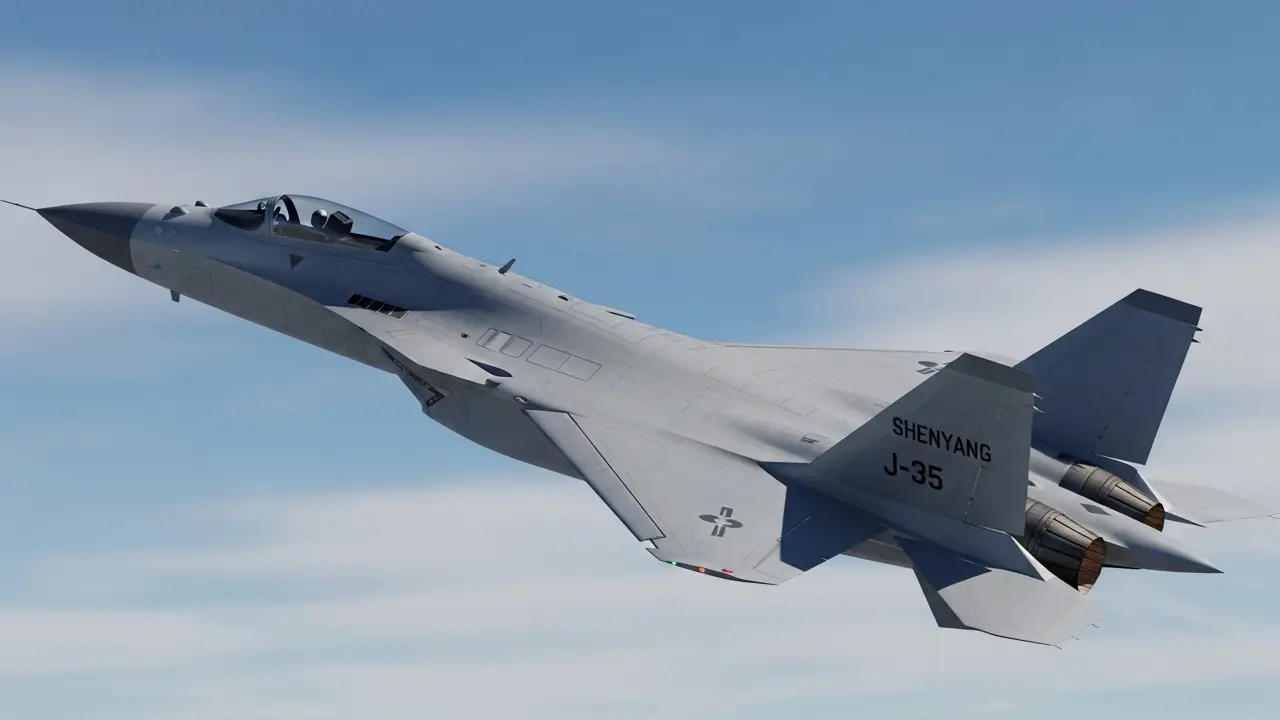
The Shenyang J-35 is one of China’s most closely watched military aviation projects, attracting global attention for its advanced design and strategic importance. As a carrier-capable stealth fighter, the aircraft represents a significant step in the modernization of China’s naval air power. Developed by Shenyang Aircraft Corporation, the J-35 is expected to complement existing platforms and enhance operational capabilities in complex combat environments.
In recent years, increasing sightings, test flights, and analysis from defense experts have provided a clearer picture of what the J-35 could offer. While official specifications remain limited, available information suggests that this aircraft is designed to compete with other fifth-generation fighters globally, particularly in terms of stealth, avionics, and multirole functionality.
Development Background of Shenyang J-35
The Shenyang J-35 is believed to be an evolution of the earlier FC-31 prototype, which was initially developed for export markets. Over time, the design appears to have been refined for domestic military use, especially for deployment on aircraft carriers operated by the People’s Liberation Army Navy (PLAN).

China’s growing focus on blue-water naval capabilities has driven the need for a modern carrier-based stealth fighter. The J-35 is expected to fill this role, potentially operating from advanced carriers equipped with catapult launch systems. Its development aligns with broader efforts to strengthen maritime defense and expand operational reach.
Design and Stealth Features
The design of the Shenyang J-35 emphasizes low observability, with features commonly associated with fifth-generation fighters. These include a sleek airframe, internal weapons bays, and carefully shaped surfaces to reduce radar cross-section.
The aircraft appears to incorporate twin engines, diverterless supersonic inlets (DSI), and canted vertical stabilizers. These elements contribute not only to stealth but also to aerodynamic efficiency. The use of radar-absorbing materials is also likely, although exact details have not been publicly disclosed.
Engine and Performance Capabilities
The J-35 fighter jet is expected to be powered by advanced turbofan engines, potentially including domestically developed options. While precise engine specifications are not confirmed, performance goals likely include high thrust-to-weight ratio, efficient fuel consumption, and sustained supersonic flight.
Speed, range, and maneuverability are key factors for modern combat aircraft. Analysts suggest that the J-35 is designed to perform both air superiority and strike missions, balancing agility with payload capacity. Its twin-engine configuration may also enhance reliability during naval operations.
Avionics and Combat Systems
Modern fighter jets rely heavily on advanced electronics, and the Shenyang J-35 is expected to feature a sophisticated avionics suite. This may include an active electronically scanned array (AESA) radar, advanced sensor fusion, and integrated electronic warfare systems.
These technologies allow pilots to process large amounts of battlefield data in real time, improving situational awareness and decision-making. The aircraft is also likely to support network-centric warfare, enabling coordination with other platforms such as drones, ships, and ground systems.
Carrier-Based Operations
One of the most important aspects of the J-35 stealth fighter is its intended role as a carrier-based aircraft. Unlike land-based fighters, carrier jets must meet specific requirements such as reinforced landing gear, folding wings, and compatibility with launch systems.
The J-35 is expected to operate from China’s newer aircraft carriers, which are equipped with electromagnetic catapult systems. This capability allows for heavier payloads and more flexible mission profiles compared to traditional ski-jump launches.
Comparison with Other Stealth Fighters
The Shenyang J-35 is often compared to other fifth-generation fighters due to its design and intended role. While each aircraft has unique characteristics, the J-35 appears to focus on versatility, combining stealth with multirole capabilities.

Its twin-engine layout distinguishes it from some single-engine designs, potentially offering advantages in range and survivability. However, as with any modern aircraft, actual performance depends on factors such as pilot training, support infrastructure, and integration with other systems.
Strategic Importance of the J-35
The introduction of the J-35 fighter jet reflects broader changes in global military aviation. As countries invest in advanced technologies, stealth fighters play a crucial role in maintaining air superiority and deterrence.
For China, the J-35 represents an effort to strengthen naval aviation capabilities and reduce reliance on older platforms. Its deployment could enhance operational flexibility in various scenarios, including maritime patrol, defense, and power projection.
Challenges and Future Outlook
Like any advanced military project, the Shenyang J-35 faces several challenges. These may include engine development, system integration, and large-scale production. Ensuring reliability and cost-effectiveness is also essential for long-term deployment.
Despite these challenges, ongoing testing and development suggest steady progress. As more information becomes available, a clearer understanding of the aircraft’s capabilities and role will emerge. The J-35 is expected to become a key component of China’s future air and naval strategy.
Specifications of Shenyang J-35
| Category | Details |
|---|---|
| Aircraft Type | Fifth-generation stealth fighter |
| Manufacturer | Shenyang Aircraft Corporation |
| Engine | Twin-engine configuration (exact model unconfirmed) |
| Role | Multirole (air superiority & strike) |
| Stealth Features | Low radar cross-section, internal weapon bays |
| Operational Use | Carrier-based operations |
| Avionics | AESA radar, sensor fusion (expected) |
| Status | Under development/testing |
Frequently Asked Questions (FAQs)
1. What is the Shenyang J-35?
The Shenyang J-35 is a next-generation stealth fighter aircraft developed in China, designed primarily for carrier-based operations and multirole combat missions.
2. Is the J-35 currently in service?
As of now, the J-35 is still under development and testing, with no official confirmation of full operational deployment.
3. What makes the J-35 different from earlier Chinese fighters?
The J-35 incorporates stealth technology, advanced avionics, and carrier compatibility, making it more advanced than previous generation aircraft.
4. Will the J-35 be used on aircraft carriers?
Yes, the aircraft is specifically designed for carrier-based operations and is expected to operate from modern Chinese aircraft carriers.
5. How does the J-35 compare globally?
While exact comparisons depend on confirmed specifications, the J-35 is considered part of the fifth-generation fighter category, focusing on stealth, advanced systems, and multirole capability.