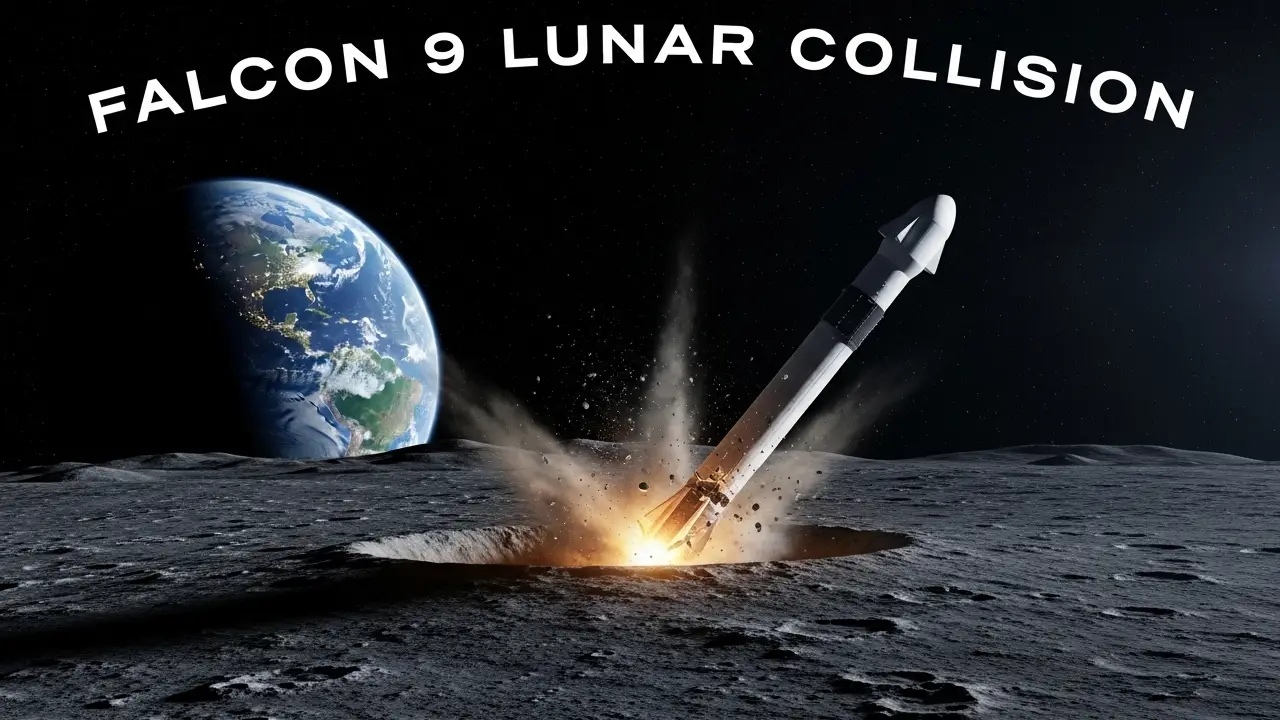
The topic of Falcon 9 lunar collision has recently gained attention among space enthusiasts and the general public. As space exploration continues to expand, incidents involving space debris and unintended impacts are becoming more relevant. This article explains what the Falcon 9 lunar collision is, how it happened, and why it is important for the future of space missions.
Space missions are becoming more frequent, with both government agencies and private companies launching rockets regularly. While these missions bring innovation and discovery, they also raise concerns about orbital debris and unintended consequences such as lunar impacts.
What Is Falcon 9 and How Does It Work?
Falcon 9 is a reusable rocket developed by SpaceX, designed to transport satellites, cargo, and astronauts into space. It has become one of the most reliable and frequently used launch vehicles in modern spaceflight.

The rocket consists of two stages. The first stage is designed to return to Earth and land safely for reuse, while the second stage continues into orbit to deliver payloads. However, not all components return, and some parts may remain in space for extended periods.
Understanding the Falcon 9 Lunar Collision Event
The Falcon 9 lunar collision refers to an incident where a piece of rocket debris, believed to be part of a Falcon 9 upper stage, eventually impacted the Moon after drifting through space for years.
This object was initially launched during a deep-space mission but failed to return or settle into a stable orbit. Over time, gravitational forces from Earth, the Moon, and the Sun altered its path, eventually causing it to collide with the lunar surface.
How Did the Rocket Stage End Up on a Collision Path?
After completing its mission, the upper stage of the Falcon 9 rocket did not have enough fuel to return to Earth or move into a controlled disposal orbit. As a result, it remained in space as debris.
Due to the complex gravitational interactions in space, the object gradually shifted into a chaotic orbit. Over several years, these small changes accumulated, eventually leading to a predicted impact with the Moon.
Impact on the Moon: What Happened?
When the object collided with the Moon, it created a new crater on the lunar surface. Unlike Earth, the Moon has no atmosphere to burn up incoming objects, so even relatively small debris can leave noticeable marks.
Scientists expected the collision to produce a measurable impact, potentially forming a crater several meters wide. However, such events are not uncommon, as the Moon is regularly hit by meteoroids and space debris.
Why This Event Is Important for Space Exploration
The Falcon 9 lunar collision highlights growing concerns about space debris and long-term mission planning. As more objects are sent into space, managing their end-of-life becomes increasingly critical.
This event also raises awareness about the need for better tracking systems and disposal strategies. Space agencies are now focusing on ensuring that future missions include clear plans for handling unused rocket stages and debris.
Challenges of Tracking Space Debris
Tracking objects in deep space is significantly more difficult than monitoring satellites in Earth orbit. Many objects are small, inactive, and influenced by multiple gravitational forces, making their paths unpredictable.
In this case, the object’s identity was initially uncertain, and scientists had to analyze its trajectory carefully to determine its origin. This shows the limitations of current tracking technologies.
Environmental Impact on the Moon
The Moon does not have ecosystems like Earth, so the environmental impact of such collisions is minimal in terms of life. However, repeated impacts from human-made objects could affect future lunar research and exploration sites.
As space agencies plan permanent lunar bases, preserving certain areas of the Moon may become important. Uncontrolled impacts could interfere with scientific experiments or future missions.

Future Solutions to Prevent Similar Incidents
To avoid future incidents like the Falcon 9 lunar collision, space organizations are exploring several solutions. These include designing rockets that can safely deorbit after missions and improving propulsion systems for controlled disposal.
Another approach is the development of international guidelines for space debris management. Cooperation between countries and private companies will be essential to maintain a sustainable space environment.
Role of Private Space Companies
Private companies like SpaceX play a major role in modern space exploration. With increased launch frequency, they also carry responsibility for managing space debris.
Many companies are already working on improving sustainability in space missions. Reusable rockets, better mission planning, and advanced tracking systems are helping reduce long-term risks.
What This Means for Future Lunar Missions
The Moon is becoming a key target for future exploration, including potential human settlements. Events like this highlight the importance of careful planning to ensure that lunar activities remain safe and sustainable.
Space agencies are now considering stricter guidelines for missions involving deep space and lunar trajectories. This will help minimize unintended impacts and protect valuable research areas.
Overview of Falcon 9 Rocket
| Feature | Details |
|---|---|
| Rocket Name | Falcon 9 |
| Manufacturer | SpaceX |
| Height | 70 meters |
| Payload Capacity | Up to 22,800 kg to Low Earth Orbit |
| Reusability | First stage reusable |
| First Launch | 2010 |
| Primary Use | Satellite launch, cargo, crew missions |
Conclusion
The Falcon 9 lunar collision serves as a reminder that space exploration comes with responsibilities. While the incident did not cause harm to life, it highlights the growing challenge of managing space debris and ensuring safe mission practices.
As space activities continue to expand, better planning, improved technology, and global cooperation will be essential. Understanding events like this helps build awareness and encourages more sustainable approaches to exploring the universe.
FAQs
1. What is the Falcon 9 lunar collision?
It refers to a piece of Falcon 9 rocket debris that eventually collided with the Moon after drifting in space.
2. Did the collision cause any damage to Earth?
No, the collision occurred on the Moon and had no impact on Earth.
3. Why did the rocket stage not return to Earth?
The upper stage did not have enough fuel for a controlled return or disposal, leaving it in space.
4. Is space debris a serious issue?
Yes, increasing space debris can pose risks to satellites, missions, and future exploration efforts.
5. Can such incidents be prevented in the future?
Yes, with better planning, improved technology, and international cooperation, similar incidents can be minimized.